

Cardiogenic Shock Best Practices
From Patient Selection to Escalation Strategies

Recognizing Patients as Candidates for Mechanical Circulatory Support Along the Spectrum of Cardiogenic Shock
This paper of Andrea Montisci, MD, et al. discusses the latest guidance for identifying patients with cardiogenic shock (CS) who are candidates for mechanical circulatory support (MCS).
From Medical Therapy to Mechanical Support – Strategies for Device Selection and Implantation Techniques
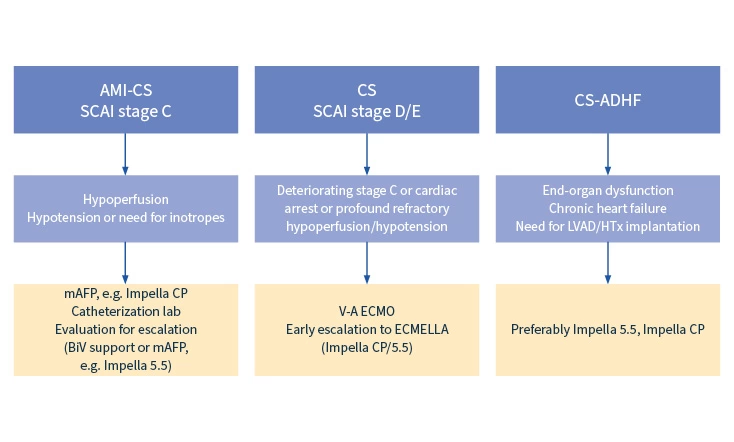
Letizia Bertoldi, MD, and colleagues describe how catecholamines and percutaneous ventricular assist devices (pVADs) are used to treat cardiogenic shock (CS). Bertoldi et al. propose an algorithm for practical management of inotropes in CS as well as an algorithm for selection of pVADs in patients with CS.

Timing and Treatment Strategies According to SCAI Classification in Cardiogenic Shock
Prof. Giuseppe Tarantini, MD, and colleagues describe a “4 early step” approach for timely management of patients with acute myocardial infarction cardiogenic shock (AMICS).
Mechanical Circulatory Support in Cardiogenic Shock

Monitoring on the ICU: Integrating Hemodynamic Assessment, Laboratory Data, and Imaging Techniques for Timely Detection of Deterioration and Recovery
For patients with cardiogenic shock (CS) supported with percutaneous ventricular assist devices (pVADs) in the ICU, Prof. Christophe Vandenbriele, MD, et al. assert that haemodynamic monitoring tools and echocardiography constitute the cornerstone of monitoring, complemented by numerous biochemical tests to optimize the management of these patients.

Differential Utilization of Impella Devices, ECMO, and Combined Therapies as Escalation and De-escalation Strategies
“The decision to escalate, de-escalate or wean is highly dependent on patient presentation, capabilities of the institution, and the expertise of the heart team,” write PD Alexander M. Bernhardt, MD, et al. of their paper on differential usage of Impella® heart pump devices, extracorporeal membrane oxygenation (ECMO) and combined strategies in patients with cardiogenic shock.

From Escalation to Weaning Strategies—How to Integrate the ECMELLA Concept
This article of Benedikt Schrage, MD, et al. describes escalation and weaning best practices for patients with cardiogenic shock supported with ECMELLA—a combination of Impella and extracorporeal membrane oxygenation (ECMO). The authors identify specific clinical scenarios in which escalation to ECMELLA should be considered and describe the concept of protected weaning for ECMELLA patients.
Discover Exclusive Author Interviews
Learn more about the "The Heart of the Matter: From Patient Selection to Escalation Strategies – Mechanical Circulatory Support in Cardiogenic Shock" from the authors.
Sign Up for Latest Updates
NPS - 624